


How to throat sing by roaring like a dinosaur
As part of Nunavut Parks’ Learn To series, group learns the traditional arts of throat singing and drum dancing

Leanna Wilson demonstrates drum dancing Tuesday during a Nunavut Parks Learn To… session on Inuit throat singing and drum dancing at Unikkaarvik Visitors Centre in Iqaluit. (Photo by Jorge Antunes)
The first step to learning how to throat sing is to make the sound a dinosaur or monster would make.
Singer and dancer Leanna Wilson described the sound as the “raarrr” — all soft Rs.
“You take that feeling [in your throat] and make a sound out of it,” said the instructor for Tuesday’s Learn To… workshop that explored the ins and outs of throat singing and drum dancing.
Wilson’s audience for the Nunavut Parks event, hosted Unikkaarvik Visitors Centre at Sylvia Grinnell Territorial Park in Iqaluit, was a small group of about 10 people.
Wilson explained that one can take that “raarrr” feeling in their throat and then say “ama,” and they will have the beginning of a throat song.
In addition to teaching participants how to throat sing, she spoke about the history of the practice.
Mothers would use throat singing almost like a lullaby to put their babies to sleep, while they were in their amauti, she said. The sounds vibrate through a mother’s back and soothe the baby.
Throat singers hold their partner by the elbow and rock back and forth.
“That helps to find the rhythm of the song, but that also helps to rock the baby to sleep as well,” Wilson said.
A lot of songs are about imitating nature. Not just the sounds, she said, but the energy, like the velocity of a rushing river or the vision of a flock of seagulls in flight.
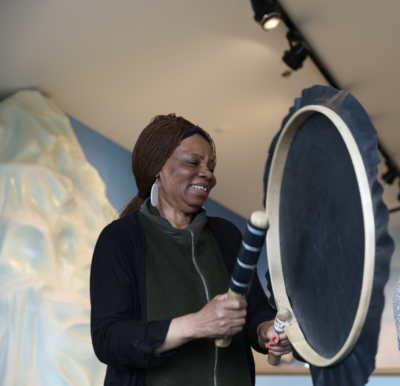
Alice Mutuwa, of Iqaluit, takes a shot at learning to drum dance during Tuesday’s Nunavut Parks’ Learn To… session on Inuit throat singing and drum dancing held at Unikkaarvik Visitors Centre in Iqaluit. (Photo by Jorge Antunes)
Modern throat singers are experimenting with new, more contemporary sounds, like the sound of “coffee brewing,” Wilson joked.
As an artist, she said she would also like to try new things with throat singing as a way to revive Inuit culture.

Throat songs were originally created to imitate the sounds of people’s surroundings, the behaviours of the environment.
“Now, in today’s world, we have coffee in the morning, we have TV, we have iPads and iPods,” she said.
“I want to mix it up.”
The group reconvened after a coffee break with a lesson on drum dancing which, traditionally performed by men, can take on a competitive nature.
Men drum against each other, beating their drums faster and dancing more elaborately, until one of the competitors tires and gives up. It’s a test of endurance and strength.

There are different styles, like the bear — or nanook — dance, which Wilson demonstrated by getting low and swaying her hips and shoulders in imitation of the gait of a polar bear.
Alice Mutuwa, who works for the Department of Justice, attended the session with her niece who had never been to the North. She said coming to a demonstration like this was great, because it gives people the chance to really feel Inuit culture.
It’s good to know the reasons behind the dances and songs, Mutawa said.
Nunavut Parks Learn To… workshops take place every Tuesday and Thursday until Aug. 29 and are free.
On Thursday, participants will get the chance to learn about Arctic survival and preparedness. On Aug. 13, people can learn about traditional place names around Iqaluit.
(0) Comments