

Questions about education dominate kickoff to Nunavut legislature’s spring sitting
Education Act amendments expected to be tabled later this sitting
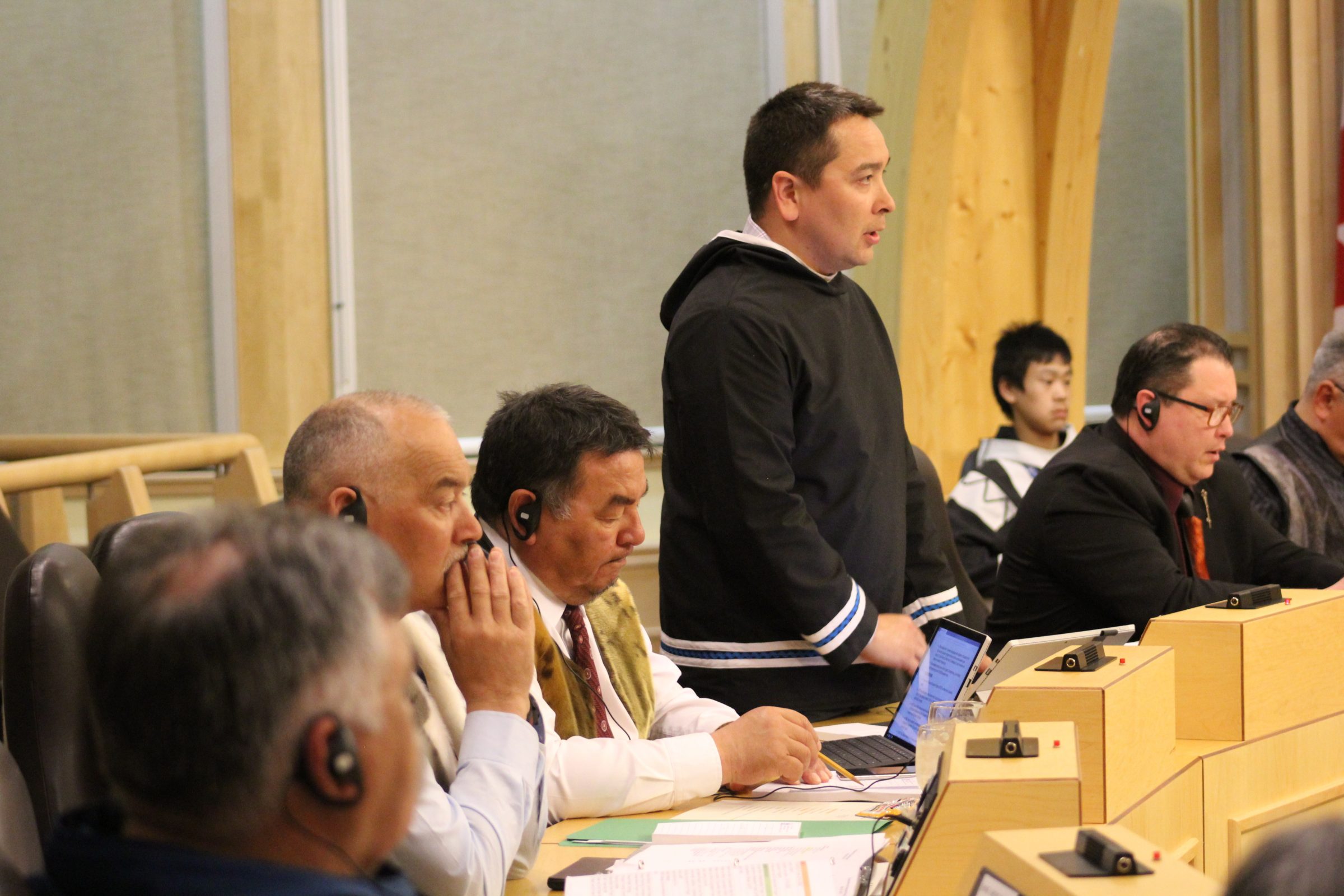
Nunavut Education Minister David Joanasie fends off questions during the opening of the spring sitting of the legislature on Tuesday, May 28. (Photo by John Thompson)
The spring sitting of Nunavut’s legislature started off on Tuesday with many questions aimed at Education Minister David Joanasie, who is expected to table amendments to the Education Act later this sitting.
Citing numbers from a departmental review, Arviat North-Whale Cove MLA John Main noted that about one in four students failed their departmental exams in 2018.
“What is the trend that the department is seeing? Are more Nunavut students passing their departmental exams? Or are more Nunavut students failing their departmental exams as time passes? Or is it staying stable?” he asked.
Joanasie said the number of students passing the exams has remained relatively stable. Graduation rates have also been increasing, with about 41 per cent of students graduating from high school in the territory, he said.
Main said although graduation rates may be increasing, he is concerned about the quality of education students receive. Some students graduate feeling unprepared for post-secondary studies because the education they receive is not “up to par” with schools in the rest of Canada.
Aggu MLA Paul Quassa asked Joanasie about the status of the teacher shortage in Igloolik. Quassa said on several occasions that Igloolik students have been asked to stay home because there are not enough teachers to keep their classes running.
In response, Joanasie said the teacher shortage is a global problem, not just a Nunavut problem. He said the department is doing as much as it can to keep students in school and he does not want a situation this fall where the territory’s schools continue to lack teachers.
Out of the 85 students attending the Nunavut Teacher Education Program, 21 will be graduating this year, said Joanasie.
He said the department has sent letters to each of those graduates encouraging them to consider a career in teaching.
Amittuq MLA Joelie Kaernerk noted that the territory’s teachers are sent to a meeting once a year in Iqaluit. He asked the minister to provide the assembly with the total expenses required to accommodate that meeting.
Joanasie said he did not have that information immediately available, but that the meetings were part of the department’s professional development framework.
Kaernerk asked if it would be possible to hold the meetings online or through a teleconference to save money that could be used to provide food to students, for example.
Joanasie said although some schools are not able to do online meetings, he would bring Kaernerk’s suggestion to the department.

The sitting resumes today at 1:30 p.m.
Correction:
An earlier version of this story stated that David Joanasie encouraged graduates of Nunavut Sivaniksavut, rather than the Nunavut Teacher Education Program, to consider a career in teaching.
Saw a post the GN put out stating in 1999 there were about 98 grads and this year 286 or something like that. How many Kindergarten kids were there in 2006?
An interesting stat would be the number of kids enrolled in Kindergarten each year and the number of high school graduates that year.
In 2006 there were 684 Kindergarten students enrolled in Nunavut Schools. For startling statistics about Nunavut enrollment statistics check out the link below provided by the Government of Nunavut. I get a kick out of the large percentage of students who are in Grade 10….social passing for the win….until they reach grade 10 and must actually complete credits.
http://www.stats.gov.nu.ca/Publications/Historical/Education/Nunavut%20Public%20School%20Enrolment%20by%20Grade%202003%20to%202017%20(6%20tables).xlsx
With all the cuts the Conservative government of Ontario is doing there is a lot of teachers that lost their jobs, maybe some of them can be hired for Nunavut?
Students enrolled in Nunavut education is a pretext failing system under 3 regional offices of dept. of education i.e. teachers down play passing marks, programs taught in class Not relevant to students EDUCATION/ learning, teachers hired to teach NOT providing quality of education, grade 12 graduates who complete end up NOT enrolling to post-secondary due to poor quality of education taught in class, staff hire to work in remote schools develop their own little contour agenda that is NOT relevant to students quality education. Lists goes on! Teachers hired should be monitored closely and curriculum programs taught in classes. This education failing system started to occur mid 2000 .
This is screed is totally incomprehensible
Don’t be quick to blame the education system. The biggest hindrance to Nunavut students succeeding in school is their parents or guardians. Often parents are so wrapped up in their own issues they do not have the time, want, capability, or desire to worry about their kids education. This should be obvious when you look at the truancy rates throughout the territory. Parents have a difficult time ensuring their kindergarten student attends on a regular basis, all of the absenteeism that occurs is a direct result of parenting.
Do not get me started on teacher absenteeism. There is a certain percentage of educators in Nunavut who miss significant amounts of work and do not have to worry about consequences. These teachers use all of their sick time every year, borrow sick time from the next year, and have numerous AWOL’s and LWOP’s on their files. Them being absent on a regular basis also affects the students education.
Here is a link for Nunavut school truancy rates….it is crazy how much time students miss in Nunavut.
http://www.stats.gov.nu.ca/Publications/Historical/Education/Nunavut%20Public%20School%20Truancy%20Rate,%202001-2002%20to%202010-2011.xls
In my grandfather’s time, grade school where he lived was only for the children of the rich. He was the 1 in a 100 who attended on scholarship.
Now the GN tries to bribe students with food for attending school and still they don’t come.
What else has changed?
So you’re blaming teachers. Well, if you knew what you were talking about, you’d know that teachers in Nunavut are monitored VERY closely already. Every teacher that has worked in the south and comes to Nunavut is floored by the amount of accountability work and paper work that’s involved. So when looking for someone to blame, I think you should look elsewhere.
Yeah? Who monitors the amount of English used, read and written in the Inuktitut immersion classes?
and who is monitoring schools who send a class of new grade 7 students with not one student on grade level for either language or math for many years?
Excellent question! I’ve asked around and teachers don’t make these decisions. So let me know when you find the answer.
I simply don’t believe the statistic that only 1 in 4 failed the departmental exam. Much more likely that he meant 1 in 4 passed the exam. But even then, he’s probably wrong and meant 1 in 4 passed the class. In the last 10 years, I can count on one hand the number of people that have actually passed the exam in our community. Pass rate for the class is high though because teachers can give a nice high class mark and the exam only counts towards 30% of the overall mark.
Hello Snappy,
2 out of 3 Nunavut students do not pass the Alberta English departmental exam. The average mark is also 40% in Nunavut There is also a 30% difference between the exam mark and course mark. So there is a disconnect between exam marks and class marks. In the community I live in, 75% of the students who took the Alberta exam this year passed the exam, that result is a rarity in Nunavut.
Here is the link to support the 2/3 failure rate and average of 40% on the exam –
https://www.cbc.ca/news/canada/north/nunavut-students-failing-exams-1.3776952
On page 21 you will find the Auditor Generals report about the 30% discrepancy –
http://publications.gc.ca/site/archivee-archived.html?url=http://publications.gc.ca/collections/collection_2013/bvg-oag/FA3-88-2013-eng.pdf
Perhaps 3 out of 4 who write the exam pass it and 1 out of 4 fail it.
Perhaps 3 out of 4 in grade 12 at the end of the year don’t write the exam.
Perhaps 1 out of 2 who enter grade 12 drop out before the end of the year.
Perhaps 9 out of 10 who enter kindergarten don’t ever get to grade 12.
—
Do you know what such statistics mean?
They mean that for every 320 students who enter kindergarten, only 32 get to grade 12, while the other 288 drop out along the way.
They mean that of the 32 who get into grade 12, only 16 complete the year, the other 16 drop out during the year.
They mean that, of the 16 who stay in grade 12 to the end of the year, only 4 students write the exam, the other 12 don’t write the exam.
They mean that, of the 4 grade 12 students who write the exam, 3 pass the exam and 1 does not.
In summary, they mean that, for every 320 students who enter kindergarten, 3 will pass the exam 12 years later and the other 317 will not.
—
Some call this a 75% success rate.
I call this a 1% success rate.
—
And of the 3 who pass the exam, perhaps 2 will go on to university.
And of the 2 who go on to university, perhaps 1 will graduate with a university degree.
—
These are “perhaps” numbers.
GN, its time for openness.
What are the real numbers?
Only when we know the real situation will we understand where the bottlenecks are and appreciate what needs to be done to improve the situation.
It is time to do ‘exit’ surveys of kids who drop out of school. They or their parents should feel comfortable talking to an external, neutral person/group. The questions should be neutral and not leading questions. This information would be useful to the Department and schools. There are far too many kids that get pushed out of the system. It is often not a sudden exit either for most kids but of course there might be the odd one that happens. Sure, some students may feel uncomfortable or even not able to express their thoughts clearly enough. There are many reasons students leave school: personal, academic, bullying, teachers, abuse, communication, parental support and much, much more. Aside from this, the system needs to build in more appropriate support for kids who are at-risk and many are at risk and vulnerable because of home situations. The system needs to find ways to support parents and provide workshops in guiding kids through highschool. The schools need to build in tutoring. It is frustrating to try and support relatives who are not ‘pushing’ their kids to stay in school. They give in so easily to their teenage children who start to miss school and the absences build up, leading to giving up because they get behind and the teachers get ‘pushy’. I see so much of that with my relatives and friends’ relatives. Teachers and educators have far more built-in supports than the students they teach.
The rates of passing the class and failing the exam are high, because for years and years, the push has just been to get more graduates, period. Parents, DEAs, some Principals, and the Department was only concerned about getting grads, if that wasn’t the case, then every time there is a large differential between class and exam mark, teachers would be questioned. They are not. Some teachers been trying to sound the alarm on this for years, but no one listens to teachers, especially not if they are the “mean” teachers who have high standards and don’t give away marks for nothing. The Department just hired a consultancy firm from somewhere else to tell them their vision, by interviewing some of their own employees. Why not just talk to the employees, without fear of reprisals? If they know they won’t get into trouble, they will talk. The consultants will be told who to interview, and it will be all people who the Department knows what they will say. It’s like the Department knows what there vision is going to be, they just want the big consultants to give them a report to say their right.
I would love to see the stats of the exam mark versus the class mark, I bet that would be a huge eye opener and would explain so much. Is this possible to be shown, without student names of course.
Ask the Department; they have the stats (have had access for years) but aren’t particularly proud of them; other comments are correct- there had been an effort to establish a policy to review a classroom mark when the difference ( average for the class) was beyond a particular amount; AB used to ( maybe still does) have a policy to discuss with the teacher if their school class average and the exam class average was higher than 15%.
Imagine that in Nunavut; some classrooms in some communities have a differential double that ( or more)…..but it takes leadership willing to demand a standard and politicians to wait to get there; it will mean students repeating classes – is Nunavut ready for that?
I have to call into questions the statistics provided by the gn on their link about graduation rates. How did they get those numbers on the graduation rates? the 2017 stats for Cambridge Bay are wrong. How many others are not accurate? Parents notice these things. If you want kids to succeed, put more pressure on families to step up, no excuses, just responsibilty. Parents fail their children in kindergarten, grade 1 and 2. Teachers fail them in grade 10. Governments fail them when they cannot keep their departments functioning and have accurate information. What a mess.
As a student from Nunavut I have always heard that my education is not on par with the rest of Canada. I had assumed that when I attended university I wouldn’t be able to keep up or I would be deemed stupid because my education wasn’t as good as one I would receive down south, however, I was surprised when I received high marks in my university courses. Yes I believe our education system could use some work but I also believe if you push yourself and take academic stream courses available and do the work you can receive an education that is on par. Also my departmental marks were not an example of how I was as a student because it took place over a month after I had finished school so I did not do as well as I would have had it taken place immediately after. As for other students in Nunavut, many have Inuktitut as their first language and departmentals are written in a way that is meant for a student that speaks English as their first language. The idea that we are lesser and not as bright as students elsewhere in Canada is damaging to our youth. Inuktituugunaqtungatau so this is written by a youth that is fluent in both languages.
The idea that you are lesser, or stupid or whatever other term you used is a imaginary set of adjectives that have been imposed on you, by no one else but yourself, presumably for dramatic effect.
My career in education started more than a decade ago. Because I am an Inuk female, I have always been labelled negatively, and it is disheartening. I am facing road blocks that do not need to be there. They are there only because I am considered incompetent because of the culture I come from. I feel sorry for our youth as they have it much harder than I did because they are expected to have dual identities and thrive in both.
Teachers hired to work in schools to provide Quality Education to students Learning in remote communities should be monitored closely including job performance review i.e. what curriculum programs are being taught in classes and if programs delivered to students in class are Quality Education to pursue further Education in Post-Secondary? You’ll notice some Teachers hired to work from outside or on contract basis end up lean towards by manipulating/ orchestrate Education system with Programs that are NOT relevant to students Quality Learning. You notice that??? You may notice majority of students complete Grade 12 but majority students may still NOT know English Grammar, Mathematics, Biology/ Chemistry, Read or Write English etc. This is reality how system is stage-manage in rural schools especially in aboriginal communities, which develops to toxic environment and poor leadership roles among staff in school. This is known as Stranded in an island. WHAT ARE the RATES for STUDENTS ENROLLING IN POST-SECONDARY???
I hope you were using the upper case letters to denote their importance. Also, being “stranded in an island” refers to being within the land mass itself – like part of the mantle or core, I presume. Stranded ON an island is the apt idiom you were shooting for. Nonetheless, Great showing…
This question has never been actively addressed: What’s the purpose of education for Inuit youth?
For Inuit to be truly equal Canadian citizens, my answer is that the goal must be for Inuit to become the doctors and dentists, geologists and mine managers, accountants and marine biologists in their own land.
However, GN has actively worked to prevent that happening. A responsible Inuit mother recently told me her son’s Grade 7 in Rankin Inlet was barely equivalent to Grade 3 when they moved to Ottawa.
Half a century ago Peter Pitseolak wrote in his memoirs that he expected his grandchildren could become full-fledged medical doctors—like the heart surgeon Donna May Kimmaliardjuk, educated in the South.
Tim Atherton, former Anglican minister in Iqaluit and then in Yellowknife researched what was going on in the heads of suicidal young people. He talked to hundreds of at-risk youth, and was reported as telling The New York Times in 2000: ”Young people would tell me ‘We are seeing all this stuff on TV, we watch the hockey games, we read the magazines — yet it is all out of reach for us.’” Tim added: “Students graduate from high school and there is nothing to do at the end of it. Life had become so fearful and hopeless that death actually seemed more welcoming.”
I’m curious about your statement that the GN is actively working to prevent Inuit youth from becoming educated professionals. That’s a bold indictment. So, how is it that this is happening? To me the GN and the Bureaucracy are struggling to improve an almost intractably bad circumstance, and their level of competence is beyond just questionable, but to say they are actively working against the success of Inuit youth is not a realistic statement.
A few days ago we read that the Department of Education has hired a southern firm to write its vision statement.
Here is a vision statement for the Nunavut Department of Education:
***
Every student who enters kindergarten in Nunavut will, 12 years and 9 months later, graduate from high school, fluent in Inuktitut, English and French.
.
Every one of those students will then either enter a Trades program and obtain their Red Seal Certification as a Journey-person, or
.
They will enter a university and graduate with a Bachelor’s degree.
.
Half of those who earn a Bachelors degree will go on and earn a Masters degree or other professional designation such as Professional Engineer or Certified General Accountant.
.
Ten percent of those who earn a Masters degree will go on and earn a PhD.
***
There, that was not so hard, was it.
***
The hard part is devising a plan for how to get from where we are now to where we want to be.
.
Once that is done, the plan has to be shared with everyone, and be believed by everyone.
***
Saying, “if only parents would send their children to school, everything would be OK”, obviously is not working, because no one believes it.
***
The biggest problem in Nunavut, the biggest problem in the GN, is the belief that all that is needed is a vision. There is a belief that, if only we have the right vision, everything will just happen by itself.
Nonsense.
My grandfather had a vision of a caribou.
So he walked over the hill and there was a caribou, standing, waiting for my grandfather to slit its throat.
Not.
My grandfather had to hunt for his caribou.
We have to work to make our visions come true.
It will take lots of work.
To quote Thomas Edison, “Genius is 1% inspiration and 99% perspiration.”
But you only get that perspiration from people who believe in what they are doing.
***
Time to stop feeling “entitled and yet deprived” and start feeling that one has an opportunity.
***
Seize the day and make it happen.